
If you have been doing industrial hygiene work for any length of time, you already know about the SKC Sampling Guide. It is a very convenient cross-reference that tells you which OSHA, NIOSH, or ASTM method applies to your contaminant, applicable agency standard, the sampling volume, flow rate, and other parameters based on the method, and the SKC products that will get the job done. For decades, the SKC Sampling Guide has existed as part of the SKC printed catalog or PDF and online; both versions are enormously helpful resources. But SKC recently released something worth taking a look at: a digital flipbook version of theSKC OSHA/NIOSH/ASTM Sampling Guide that takes that same trusted content and delivers it in a noticeably beneficial format.
The Digital SKC Sampling Guide debuted at AIHA Connect earlier this year, and if you have not had a chance to explore it yet, this post will give you a sense of what it is and how its functionality and features can benefit you daily.
Here is the link to the Digital SKC Sampling Guide.
What is Different About the Digital Version?
The content is the same OSHA/NIOSH/ASTM sampling reference IH professionals have always relied on. What changed is how you experience it.
The traditional PDF version works fine, but it has the usual limitations: you scroll through a long document, lose your place, and the experience feels like reading a scanned manual rather than using a professional reference tool. The printed catalog is excellent, but obviously not something you pull up on your phone at a job site, and the printed version cannot be updated until the next version is released two years later. The online Sampling Guide is also excellent but if working in an area where there is no cell service or Wi-Fi, you don’t have the option of downloading it to your phone or tablet or printing it and throwing it in a binder.
The Digital SKC Sampling Guide flipbook changes that. Instead of scrolling, you turn pages, just like you would with a physical book. The layout is clean and polished. It reads like a professional publication rather than a document printed to PDF. And, it is still fully searchable, so you can jump directly to the contaminant or method you need without flipping through everything manually.
For those of us who have used the print guide for years, the digital flipbook feels familiar in the right ways. The format and organization are consistent with what you already know. It just works better on a screen.
What the Sampling Guide Actually Contains
The Sampling Guide is organized alphabetically by chemical hazard. Each entry provides everything you need to plan and execute a compliant air sample:
Applicable agency reference (NIOSH, OSHA, or ASTM method number)
Regulatory standard, including the TWA and STEL in ppm or mg/m3
Required sample volume in liters
Pump flow rate or range in ml/min for TWA and/or STEL sampling
Analytical method
Recommended SKC collecting equipment such as pumps and sampling media, with specific product numbers that are linked to the individual online product page
An alternative SKC product configuration where applicable
To give you a concrete example of how this looks in practice, see my screen shot below showing theSilica, crystalline (respirable) by XRD by NIOSH Method 7500 line item.

Moving from left to right:
You see the chemical hazard of interest and the agency reference (method).
Next are the agency standard, sampling volume in liters, flow rate in ml/min, and sampling time (listed as "varies" for this particular entry), each of these are listed as TWA and/or Ceiling/STEL depending on the standard and method.
And finally, the Guide lists the analysis type/method and the recommended SKC collecting equipment and media. Here is the product listed to specify your sampling train for our example: Filter Cassette 225-8208A, Cyclone 225-01-02, Cassette Holder 225-1, Pump 220-5000TC.
(An alternative is listed in the last column above. For this entry, you could substitute a preloaded, preweighed PPI Sampler in place of the filter cassette, cyclone, and cassette holder, if desired.)
Compare that entry to this screen shot of theSilica, crystalline by IR by NIOSH 7602 entry below.

This uses the same 0.05 mg/m3 TWA but calls for a different media setup: Filter 225-5-37-P, Cassette Holder 225-1, Cyclone 225-01-02, Cassette Blank 225-309, and Pump 220-5000TC. The distinction matters! These entries in the Guide, make it easy to see the difference between the two of them.
For something less familiar, like Siloxanes, the Sampling Guide takes you out of the standard filter or sorbent tube approach and points you primarily to a Sorbent Tube 226-09 with Pump 220-5000TC, but alternatively to collection equipment using Sample Bag 262-01. That kind of specificity is exactly what makes this guide valuable, especially when you are dealing with a contaminant you do not sample every day.
Why the Flipbook Format Matters for Working IH Professionals
There is a practical difference between a reference you tolerate and one you actually enjoy using. The PDF version of the SKC Sampling Guide is useful. The Digital SKC Sampling Guide flipbook is genuinely pleasant to work with, and that is not a small thing when you are using it regularly.
The page-turning interface makes navigation feel natural. If you know roughly where a contaminant falls alphabetically, you can move through the guide the same way you would with a physical book, rather than dragging a scroll bar through hundreds of pages.
The search functionstill works exactly as you would expect. Type in the contaminant name or CAS number and it provides results; simply click the entry you want to go to directly. You are not giving up any of the functionality of the PDF version, you are adding a better browsing experience on top of it.
The visual presentationis cleaner and more professional than a standard PDF. The layout is the same structured table format industrial hygiene professionals are used to, but it renders well on any screen size without the formatting artifacts you sometimes get when a print document is converted to PDF.
Accessibility from any devicemeans you can pull it up online on your laptop, tablet, or phone. You can also download it as a PDF to those same devices for offline use. A bonus is that after downloading the PDF, you can also print sections of the Guide or the whole thing, if that is the most helpful format for you. Whether you are in the office planning a survey, traveling to a facility, or reviewing method requirements the night before a site visit, the Guide is available.
Shareabilityis a practical bonus. Sending a colleague a direct link to the Guide is faster and cleaner than attaching a PDF or pointing someone to the printed catalog. For teams that include multiple IH professionals, safety managers, or contract hygienists, having everyone working from the same current reference is valuable.
The most up-to-date version of the Guide.As revisions are needed, the SKC Team is on it, making real-time changes so that any time you access the Digital SKC Sampling Guide, it is always the latest.
Who Gets the Most Out of the Guide
An honest answer is that anyone doing air sampling work will find it useful. But a few groups stand to benefit most.
CIH professionals and IH practitionerswho are already familiar with the print guide will notice the benefits immediately. The content is what you already trust. The experience is better.
EHS managers and safety professionals who need to understand what their sampling program requires will find the guide easier to navigate than a dense PDF. The structured format makes it accessible even if you are not using it daily.
IH students and early-career professionals will find it an excellent learning tool. Seeing how regulatory standards, method requirements, and specific SKC products connect in a single organized reference is one of the more efficient ways to build practical sampling knowledge.
Occupational health consultants and industrial hygiene labs who need to confirm that samples were collected using the correct media and method for a given analyte will find the guide a quick and reliable reference for that verification.
A Few Tips for Getting the Most Out of the Guide
Bookmark the link now, before you need it in a hurry. Having the URL saved in your browser or Notes app means it is one click away rather than something you have to track down mid-survey prep.
Use the search feature as your starting point when you know the contaminant name or CAS number. Browsing is easy in the flipbook format, but search is still the fastest path to the exact entry you need.
Cross-reference with your lab before sampling. The guide gives you the recommended method and media. A quick confirmation with your analytical lab that they are set up for that specific NIOSH or OSHA method prevents the kind of mismatch that creates headaches after samples are already collected.
Share the link with your team. The Digital SKC Sampling Guide is free and accessible to anyone with the link. Getting your whole team familiar with the same reference is one of the simpler ways to improve consistency in your sampling program.
Worth a Few Minutes of Your Time
The Digital SKC Sampling Guide is not a reinvention of the reference. It is the same guide you already rely on, in a format that is easier to use and more appropriate for the way IH professionals actually work today. The flipbook experience is genuinely better than scrolling a PDF, the presentation is more professional, and the content is exactly what you need to plan and execute compliant air sampling.
SKC, Inc. has been the global leader in sampling solutions and expertise for OEHS professionals for decades. Resources like this are part of what makes the relationship between SKC and the industrial hygiene community more than just a vendor transaction. Take a few minutes to open the Guide, walk through a contaminant you sample for regularly, and see how it compares to your current reference workflow.
As always, if you have questions about method selection, sampling media, or anything related to your air monitoring program, the SKC Team is here to help.
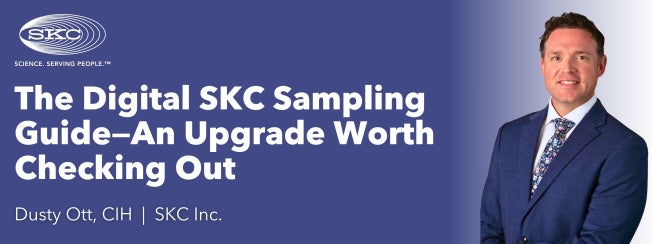
Dusty Ott, CIH is the Corporate Industrial Hygienist at SKC, Inc., the global leader in sampling solutions and expertise for OEHS professionals. SKC manufactures and supplies air sampling pumps, sampling media, and accessories used by industrial hygienists and occupational health professionals worldwide.
This SKC Air Sampling Guide is a reference for assisting users and should not be used as a substitute for reviewing applicable government regulations, equipment operating instructions, or legal standards. Users must consult the appropriate sampling method for the compound of interest before sampling. The sampling parameters shown here are suggestions based on the ranges or volume, flow, and time specified in the methods. It is the responsibility of the analyst performing the sampling and analysis steps to adjust the parameters so that the required detection limits can be obtained. The information contained in this document should not be construed as legal advice or opinion nor as a final authority on legal or regulatory procedures.
The content of this post is for informational or educational purposes only and is not intended as a substitute for professional advice. SKC is not responsible for any damages or losses that may result from the use of the information or products mentioned in this post. While striving for accuracy, SKC does not guarantee that the information is always completely accurate, reliable, or up to date. Views and opinions expressed in this post belong to the author and do not necessarily represent the views of SKC.